
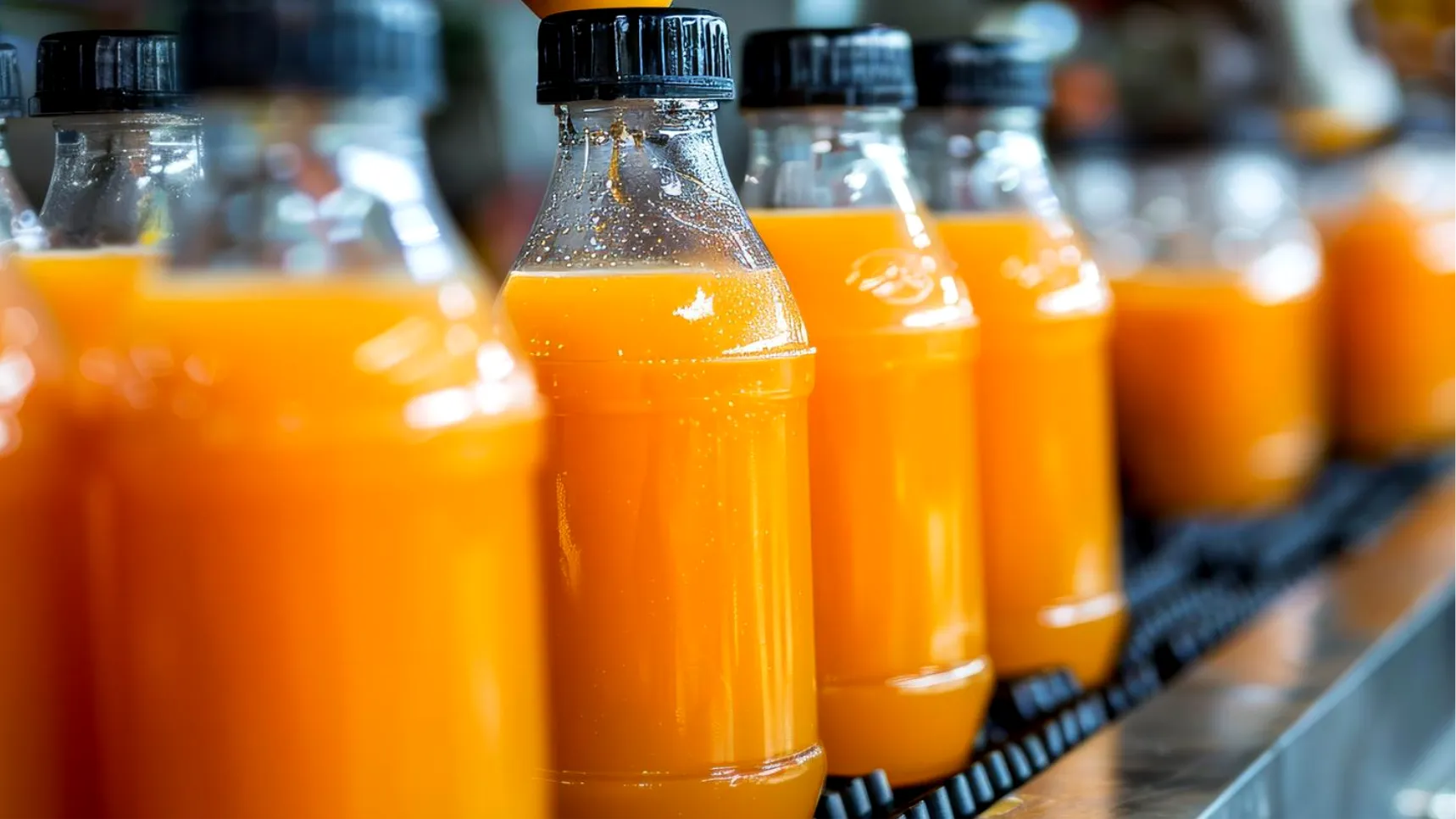
The worldwide packaged fruit juice market is flourishing. The industry is set to touch ₹16.6 trillion in the next few years due to increasing health awareness, urbanisation and increasing demand for ready-to-drink beverages. This is a great window of opportunity for entrepreneurs and manufacturers; however, it takes more than just capital to set up a successful fruit juice processing plant. It demands the right process knowledge, the right machinery and the right partners.
This guide is your full road map: everything that you need to know about the manufacturing process of juice, the equipment you will require, the estimated cost of setting up the business, licensing and what makes the difference between a profitable business and an unprofitable loss.
Quick Overview: The Fruit Juice Production Process at a Glance
To get the general picture before getting down to details, the following is the essence of the production flow of a commercial juice plant:
Raw Fruit Procurement → Washing and sorting process → Peeling and crushing → Juice extraction → Filtration → pasteurisation → Blending and formulation → filling and bottling → Packaging and storage.
All these processes require specialised equipment, quality check points and process controls. Each step is detailed out in the sections below.
What Is a Fruit Juice Processing Plant?
A fruit juice processing plant is a food-grade food processing plant that converts fresh fruits to commercially packaged juice products – fresh juices, concentrated juice, NFC (not-from-concentrate) juice and blended drinks.
These plants are small-scale with 500 liters per hour production to large, automated plants with 10,000 or more litres per hour production. The kind of plant that you require will be based on your intended market, distribution model and budget, which we will discuss in this guide.
Types of Juice Products Manufactured
- Fresh / Cold-Pressed Juice—Minimal processing, low shelf life, and high price.
- Pasteurised Packaged Juice — The most popular commercial form, with a longer shelf life.
- Juice Concentrates — Water taken out for export or industry.
- Blended/Nectar beverages—juices with water, sugar and additives.
Business Opportunity and Market Demand
The Indian juice and beverage market alone is increasing at a CAGR of more than 15% and Tier 2 and Tier 3 cities are creating a boosted demand for branded packaged juices. Consumers the world over are turning away from carbonated drinks to natural and fruit juices, a structural movement that is continuing to gain momentum.
The economics are attractive to B2B investors and manufacturers:
- Large mark-ups on branded and own-label juice products.
- Production occurs all year round due to the diversification of fruit sourcing.
- Export opportunities in concentrates and aseptically packed products.
- The prospects of contract manufacturing for large FMCG brands.
The barrier to entry is knowledge and the appropriate equipment—not the market demand. That has already been a demand that is increasing.
Process of Making Juice step-by-step
Step 1: Raw Fruit Procurement
Quality begins at the farm gate. Commercial juice plants normally enter into agreements with growers or aggregators of fruits to maintain a constant supply of raw material that is graded. Intake tests are fruit maturity, Brix level (sugar content), and microbial load.
Notable factors are sourcing seasonability, logistics of the cold chain and rejection procedures of damaged and overripe fruit. One of the least appreciated success factors of the fruit processing business is the establishment of a strong procurement network.
Step 2: Washing and sorting
Fruits are washed in industrial washing systems (usually brush washers, spray washers or flotation tanks) which eliminate soil, pesticide residues and external contaminants. A series of wash steps using food-grade sanitising agents is also normal practice in hygienic food processing plants.
Following washing, sorting is performed manually, either on the inspection conveyor belts or with automated optical sorting machines which reject atypically small or discoloured or damaged fruit. This move is a direct measure to safeguard the quality of downstream juice and avoid contamination.
Step 3: Peeling and Crushing
The following process depends on the type of fruit, which can be peeling (citrus, mango and pineapple), de-stoning (peaches and plums), or direct crushing (grapes, berries and apples). Fruit peeling machines and fruit crushers are industrialised to suit the type of fruit.
In crushing or pulping, the structure of the fruit is broken to free the juice. In certain processes, e.g., apples, an enzyme treatment is used at this stage to enhance the yield of juice and clarity. It is important that it be crushed properly: too coarse crushes on the table; too fine will give too much pulp that overburdens filtration.
Step 4: Juice Extraction
This step is the most critical part of the process. Two predominant technologies are the following:
Screw Press/Hydraulic Press: Ideal for high-fibre fruits and pulp extractions.
Decanter Centrifuge - Centrifuge of high speed to ensure clarity and efficiency.
In the case of citrus fruits, special reamers and in-line extractors are employed. In the case of tropical fruits, such as mangos and guavas, the pulpers and finishers subsequently separate the juice and fibre and seeds. Efficiency of juice extraction – which can be expressed as 'kg of fruit input per kg of juice out' – directly influences your production economics.
Step 5: Filtration
Raw extracted juice is characterised by suspended solids, pulp particles and colloidal matter that influence its appearance, stability and shelf life. Filtration is done in stages:
- Coarse filtration— Vibrating screens or rotary drum filters can remove large particles.
- Fine filtration — plate-and-frame filters or membrane filters for clean output
- Microfiltration (for premium products) – Eliminates microorganisms without heat.
The specifications for filtration vary depending on whether your product is clear juice, cloudy juice or pulpy nectar – all with different commercial positions.
Step 6: Pasteurisation
Commercial production of juice cannot be done without pasteurisation. It removes harmful microorganisms and greatly prolongs the shelf life without any artificial preservatives.
The two main techniques of an industrial juice plant are the following:
- HTST (High-Temperature Short Time) - Juice is heated in the range of 72-85°C within 15-30 seconds, followed by a rapid cooling process. Most packaged juices are of this industry standard.
- UHT (Ultra-High Temperature) - Treatment of 135-150°C for 2-5 seconds, used with ambient-shelf, aseptically packed products with a shelf life of 6-12 months.
The most widely used equipment in this case is plate heat exchangers, which are also energy efficient due to the ability to regenerate heating. A pasteurisation procedure has to be authenticated and registered in compliance with food safety.
Step 7: Blending and Formulation
After pasteurisation, juice is pumped into blending tanks where it could be standardised to a specific Brix, pH and flavour profile. Depending on the recipe of the product, sugar syrups, vitamin premixes, citric acids and natural flavours are added.
This phase is where your brand differentiation will occur. The consistent blending formulation – performed by automated dosing devices and inline mixing – guarantees uniformity in products between batches, which is essential for retail and institutional purchasers.
Step 8: Filling and Bottling
Depending on the format of the packaging, the filling stage is different:
- PET Bottle Filling – hot-fill or cold-fill lines for retail bottles.
- Tetra-Pak / Aseptic Carton Filling – For ambient-shelf products.
- Pouch Filling – Economy segments flex packs.
- Glass Bottle Filling – Good or export-grade products.
The modern juice bottling plant machinery is in positive-air-pressure clean rooms to reduce recontamination. Depending on the size of the plant, filling speeds are between 1,000 and 30,000+ bottles per hour. The filling line is combined with capping, sealing, and nitrogen flushing (to maintain shelf-life).
Step 9: Packaging and Storage
Case packing is done after bottles are filled, through a labelling machine, date-coding machine and shrink wrap bundlers. The completed products are palletised and transferred to storage facilities that are temperature-controlled.
In the case of ambient products, dry warehousing is adequate. In the case of fresh or chilled juices, storage at 2-4°C is required. Modern trade and institutional buyers are increasingly demanding traceability systems in the form of batch codes and QR labelling.
Machinery and Equipment Required for a Juice Plant
A mid-scale, fully equipped juice bottling plant consists of the following machinery:
|
Equipment |
Function |
|
Fruit Washing Machine |
Multi-stage cleaning of raw fruit |
|
Fruit Sorting Conveyor |
Manual/automated quality grading |
|
Fruit Crusher / Pulper |
Size reduction and juice release |
|
Juice Extractor / Screw Press |
Primary juice separation |
|
Vibrating Sieve / Filter Press |
Multi-stage juice clarification |
|
Pasteurizer (HTST/UHT) |
Thermal treatment for safety |
|
Blending and Mixing Tanks |
Formulation and standardization |
|
Automatic Filling Machine |
Bottling at speed and hygiene |
|
Capping and Sealing Machine |
Container closure |
|
Labeling and Coding Machine |
Branding and traceability |
|
CIP (Clean-in-Place) System |
Automated hygienic line cleaning |
|
Cold Storage / Refrigeration |
Finished goods preservation |
JPEE ENGINEERS provides total turnkey juice plant solutions, such as supplying single machines to entire plant design, installation, commissioning and after-sales services. Having a customised equipment configuration tailored to the type of fruit, the capacity and the target product shape, they are an effective one-window solution for the new and growing juice makers.
Fruit Juice Processing Plant Set-up Cost
Fruit juice plant setup cost is one of the most vital choices you will make. The following are practical scales according to the size of plants:
Small-Scale Plant (500–1,000 LPH)
Machinery: ₹25–50 lakhs
Civil & Utilities: ₹10–20 lakhs
Working Capital (raw material, packaging, and labour): ₹10-15 lakhs.
Licensing & Compliance: ₹2–5 lakhs
Total Investment: ₹50–90 lakhs
Medium-Scale Plant (2,000–5,000 LPH)
Machinery: ₹80 lakhs - ₹1.5 crore.
Civil & Utilities: ₹20–40 lakhs
Working Capital: ₹25–40 lakhs
Total Investment: ₹1.5–2.5 crore
Large-Scale / Industrial Plant (10,000+ LPH)
Machinery: ₹3–8 crore+
All-inclusive Cost of the project: ₹6-15 crore+
ROI Projections: Mid-sized juice plants operating optimally have payback times of 35 years and EBITDA margins of 15-25% based on product mix and distribution coverage. Export orders and private-label contracts can greatly hasten returns.
JPEE ENGINEERS assists clients with financial planning, assessment of right-sizing their investment and project conception up to the financial planning to prevent expensive over-engineering at the start.
Licences and Food Safety Requirements
To run a juice manufacturing plant in India, the following clearances are required:
- FSSAI Licence – All food processing enterprises are required to have a licence; the licence category depends on the scale (State/Central).
- BIS Certification – Some packaged beverages must have this certification.
- GST Registration – Standard business compliance.
- Factory Licence – As per the Factories Act, the fee is based on the number of workers.
- Pollution Control NOC – Wastewater and effluent control compliance.
- ISO 22000 / HACCP Certification – Gaining more and more demand from institutional and export buyers.
Hygienic standards for food processing require contact surfaces with stainless steel (SS304/316), CIP systems, positive-pressure-filled clean rooms and documented sanitation procedures. They are not post hoc decisions but design decisions and this is why selecting a knowledgeable plant design partner is crucial.
Major Challenges in the Juice Processing Business
1. Shelf Life Management
The threats to shelf life are mainly microbial contamination and oxidation. Solution: invest in proven pasteurisation, aseptic filling and good packaging with oxygen barriers.
2. Consistency in Supply of Raw Materials
The quality and prices of fruits vary with the season. Solution: multi-source procurement of frozen pulp as a buffer stock.
3. Quality Control Consistency
Retail buyers are annoyed with batch-to-batch variation. Solution: automated Brix and pH-dosing, in-line sensors and documented SOPs.
4. High Initial Capital
Resolution: staged capacity growth – beginning with a smaller line and scaling up machinery as revenue increases. JPEE ENGINEERS can provide modular plant designs that are ideal for this type of expansion.
Buyer Decision Guide: Choosing the Right Plant Setup Partner
Where to look when considering suppliers of machinery and partners in plant setup will be the following:
- Do they provide turnkey services or equipment only?
- Do they have experience of running plants of similar scale?
- Do they provide installation, commissioning and training of operators?
- What is their network of after-sales service and response time?
- Are they able to sustain regulatory paperwork and FSSAI compliance?
Buyer traps are buying cheap imported equipment without domestic service, under-calculating utility (power, water and steam) needs and omitting CIP systems to save money only to be caught in contamination closure.
JPEE ENGINEERS has established itself as a player in the food processing machinery industry as a company that does not only provide equipment but also full-plant engineering, layout design, utility planning, compliance support and after-sales services. Their fruit knowledge and ability to produce on a large scale make them a reliable ally to both new investors and those manufacturers who are growing.
Professional Advice to operate a profitable Juice Plant
- Begin with 2-3 SKUs and master them, then increase the product range.
- Invest in cold chains early on when dealing with fresh or short-shelf-life products.
- Guarantee institutional off-takes (airlines, hotels and hospitals) and retail to stabilise cash flow.
- Keep an eye on fruit yield ratios every week – a 5% change in extraction yield can be significant.
- Automate where it counts – filling and pasteurisation lines are not expensive to invest in; manual sorting can be added later.
- Record all that – buyers, auditors and banks all wish to have traceability records.
Ready to Set Up Your Juice Plant? Get Expert Guidance from JPEE ENGINEERS
If you are serious about entering the fruit juice processing business (or expanding a similar business), the cost of a miscalculation in the planning phase far exceeds the cost of hiring an expert to guide you from the start.
JPEE ENGINEERS has the following:
- Free plant layout design consultation
- Extensive machinery specifications of your capacity and fruit type.
- Project cost estimation and ROI analysis (realistic).
- End-to-end turnkey installation and commissioning
- Post-installation support and training of operators.
You may be starting a small ₹50 lakh startup or a multi-crore industrial plant; our experienced team of engineers will make sure that you get it designed, on schedule and within your budget.
Call JPEE ENGINEERS now and have a free consultation with them and they will provide you with a tailor-made plan proposal for your business. We provide complete enquiry solutions with a project report and machinery cost sheet within 48 hours.
Conclusion
The establishment of a fruit juice processing plant is a huge yet fruitful business investment. The business potential is actual, the demand is long-term and the technology is available, but the trick is to get every stage of the juice-manufacturing process right, invest in the appropriate equipment and collaborate with individuals who have made it happen.
Washing of raw fruits to automated bottling, all the steps of this business require accuracy, discipline and hygiene processes. Armed with the right advice, realistic cost planning and an adept technology partner such as JPEE ENGINEERS, you can develop a juice manufacturing operation that is efficient, compliant and scaled to size.
The decision now rests with you. The market is there.
