
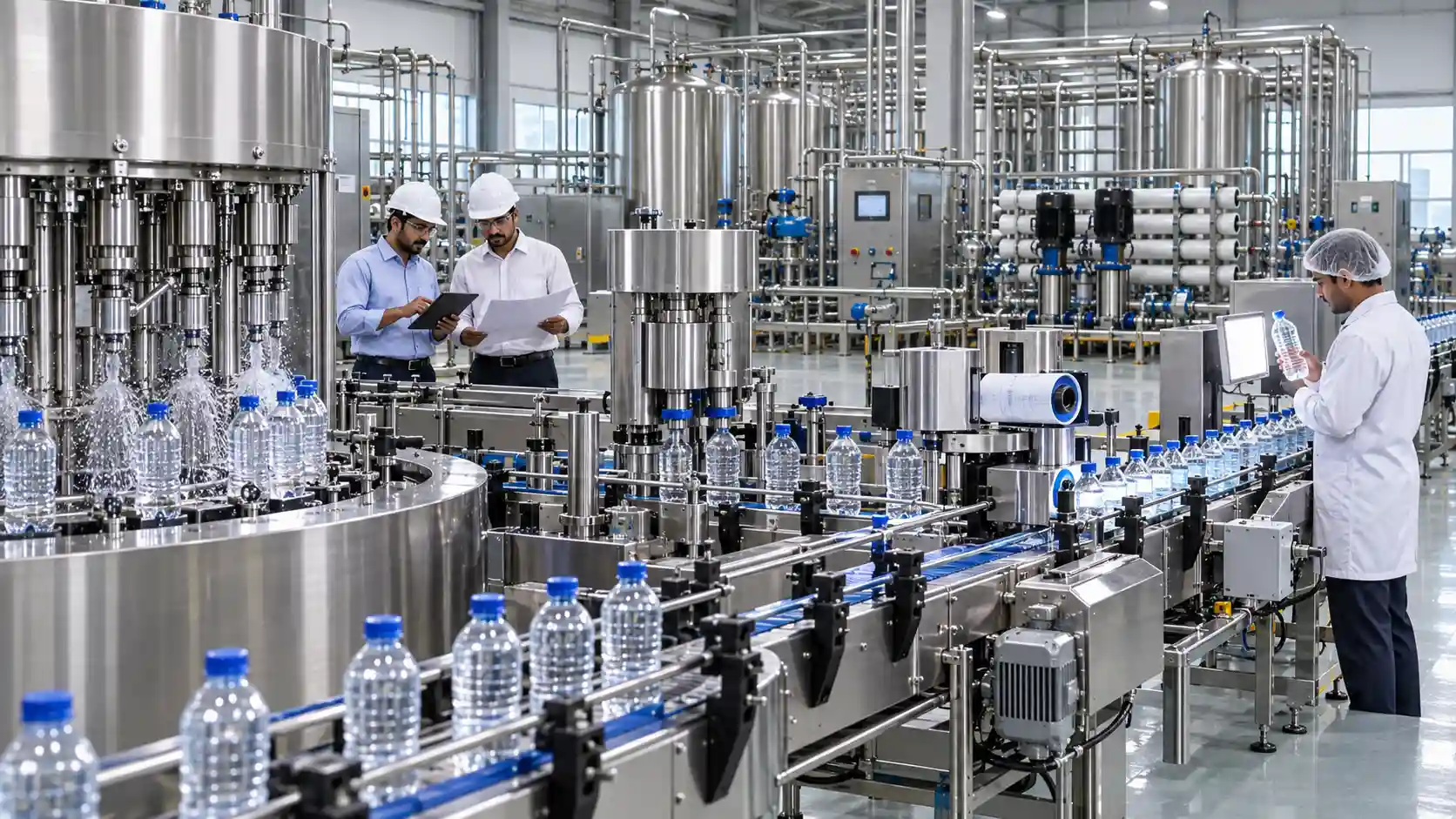
Go to any store in India and you will find dozens of water brands but demand is rising each year. Why? Due to safe drinking water becoming not a luxury. It is a daily requirement of homes, offices, hotels, hospitals and travelers. Each closed bottle is accompanied by a carefully designed Packaged Drinking Water Plant which transforms raw water into a reliable product.
However, one faulty machine or one faulty supplier can cost you lakhs. In this guide you will learn about features, benefits, costs, set up steps and smart buying tips, which means your initial investment is your best investment ever.
What Is a Packaged Drinking Water Plant?
A Packaged Drinking Water Plant is the entire system that cleanses the raw water and then bottles it, ready to sell. Consider it as a production line of water as a raw material and branded water as a safe product. A typical modern Drinking Water Plant typically has the following flow:
- Intake of water: borewell, municipal or surface source.
- Primary filtration: sand and carbon filters do away with dirt, chlorine and odour.
- RO purification: eliminates dissolved salts and heavy metals.
- UV and ozone disinfection: guarantees the safety of microbes.
- Capping, rinsing and filling: hygienic and automated.
- Labeling and filling: ready to dispatch cartons.
Key Features to Look For
All Packaged Water Plants are not constructed in the same way and therefore compare these before making up your mind. What might seem like an inexpensive plant today might turn out to be costly in case it does not grow with your expansion.
- Capacity: from 500 LPH up to 20,000+ LPH
- Speed: 30 BPM to 120 or more BPM.
- Automation: semi-automatic or fully automatic, and PLC-based controls.
- Construction: stainless steel food-grade contact parts.
- Hygienic design: contamination-free flow, easy to clean.
- Scalability: capacity to expand as your brand expands.
Main Machines in a Water Bottling Plant
A full Water Bottling Plant is like a relay team, whereby each machine must hand over the baton to the other without any hitch. Any slowness or poor match of one unit is a blow to the entire line.
- Water Bottle Filling Machine: fills each bottle accurately at your required speed
- Water Bottling Machine (rinsing unit): cleans and sterilizes bottles, then fills them.
- Capping machine: puts on and seals the caps automatically.
- Labeling and coding unit: adds brand labels and batch codes.
- Shrink wrapping and group packing: packages cartons to be sent out.
- Blow molding machine: is a machine that allows you to make your own PET bottles using preforms.
Trivia: “In 1783, Geneva jeweler Jacob Schweppe invented a way to carbonate water and started to market it in bottles. Bottled water has been a business for more than 240 years!”
Benefits of Setting Up Your Own Bottled Water Plant
A Bottled Water Plant is among the more stable beverage companies since individuals require water daily and seasonally. Partners like J.PEE Engineers & Packaging Pvt. Ltd. help you tap into this consistent demand. Packaged water does not usually get out of fashion as opposed to trend-based products.
- Consistent demand: homes, offices, events, hotels and travel
- Homebrand opportunity: create your own brand.
- Scalable model: order small, scale with increasing orders.
- Various forms: bottles, jars and so on.
- Local benefit: benefit your own area through quicker service.
How a Water Filling Plant Is Set Up: Step by Step
Most of the first-time owners are confused when starting but it is easy when the process is separated into steps. An average Water Filling Plant project flows as follows:
- Step 1: Feasibility check and analysis of raw water.
- Step 2: Planning of plant design and layout.
- Step 3: Custom manufacturing of the machine to your requirements.
- Step 4: Civil coordination and site visit.
- Step 5: Installation, commissioning and operator training.
- Step 6: Commercial launch, trial and licences.
By involving a turnkey partner, all these steps can be handled by the same roof, which will save time and reduce the number of coordination headaches.
Packaged Drinking Water Plant Cost in Delhi
The Packaged Drinking Water Plant Cost in Delhi will not be a standard price, as each of the plants is tailored to your requirements. Small installations begin with a few lakhs, and large turnkey installations are more expensive. Key cost factors:
- Plant capacity (LPH and BPM)
- Level of automation
- The quality of raw water and treatment requirements.
- Space, civil works and utilities.
- Type of bottle and packaging.
- Certification and compliance assistance.
The most effective method of knowing your actual number is a personal quote depending on your source of water and the quantity of production you desire.
Licences and Standards You Should Know
There is quality and legality in this business. Your paperwork should be prepared before you sell one bottle. Each state may have its own requirements and therefore, always check with the local authorities.
- BIS certification: packaged drinking water should be in accordance with IS 14543.
- FSSAI licence: the registration of your unit in food safety.
- GST registration: required to bill and tax.
- Local approvals and pollution control: as applicable to your premises.
- Labelling compliance: proper batch codes and pack details.
How to Choose the Right Packaged Drinking Water Plant Manufacturer in India
The choice of a packaged drinking water plant manufacturer in India is more important than the choice of the lowest-priced machine. Manufacturers like J.PEE Engineers & Packaging Pvt. Ltd. are known for meeting this checklist:
- Turnkey capability: design-commissioning single roof.
- In-house production: improved quality control.
- Conformance support: BIS, FSSAI and IS 14543 standards.
- After sales service: real spare parts and fast service.
- Past experience: request previous projects and references.
- Export experience: an international-grade engineering indication.
Common Mistakes Buyers Make
Keep these pitfalls that slug most first-time owners at bay:
| Mistake / Pitfall | Recommended Fix |
|---|---|
| Skipping water analysis (Wrong treatment design wastes money) | Test your raw water first |
| Buying only machines (Managing many vendors causes delays) | Choose a turnkey partner |
| Ignoring future growth | Pick a scalable plant design |
| Overlooking certification | Plan BIS compliance from day one |
| Neglecting service | Confirm spare parts and training support |
Did You Know?
“Such a slight alteration of the quality of raw water like increased TDS or hardness can result in a different kind of filter and the RO capacity your plant will require. This is why water testing is always prior to machine selection!”
Maintenance Tips to Keep Your Plant Running Smoothly
A good plant deserves good care. Regular upkeep protects water quality, reduces breakdowns and extends machine life.
- Sanitize sand and carbon filters at regular intervals.
- Change RO membranes and UV lamps as necessary.
- Clean tanks, pipes and filling heads frequently.
- Sample water at each step.
- Have authentic spares available.
- Daily checks by train operators.
Conclusion
The key to a successful packaged drinking water plant is not all about purchasing machines. It has to do with making the right capacity choice, the right technology choice and above all, the right partner who will be there with you long after installation. A well-designed plant is a sure way to shield your quality as well as your profits whether you are starting your first bottled water business or expanding on an already existing operation.
|
Are you willing to make your idea a running business? Call now!! |
Frequently Asked Questions
A packaged drinking water plant cleanses raw water by filtering, RO, and UV or ozone disinfection and puts the purified water into bottled containers. The mineral water plant works in a similar manner but includes a mineral-balancing step; hence, the water has a regulated amount of essential minerals. Both should be based on BIS standards. The correct option is based on your target market, the positioning of your brand and the quality of raw water.
A full system consists of a water treatment device (sand and carbon filters, RO, and UV), a bottle rinsing device, a water bottle filling device, a capping machine, a labelling and coding system and a shrink wrapping or group packing system. A blow molding machine will also be required in case you are interested in making your own PET bottles. The level of capacity and automation is based on your intended production.
Yes. High TDS is a typical problem and can be resolved with the assistance of appropriate treatment design. A water analysis will indicate your TDS, hardness and other contaminants. On that, the treatment system will be able to be scaled with the corresponding RO capacity and pre-filtration. This is why the best thing to do is to test your raw water and then decide which machine is the best.
The majority of downtime is due to inadequate maintenance or unavailable spares. Clean filters regularly, replace RO-membranes and UV-lamps as necessary and sanitize tanks and filling heads on a regular basis. Have actual spare parts and educate your operators on daily checks. With good after-sales support, you have an option of a manufacturer who will assist you when you need them.
Yes, J.PEE Engineers & Packaging Pvt. Ltd. provides a complete turnkey solution, such as the analysis of the raw water, design of the plant, manufacturing in-house, installation, commissioning, training of the operator and spare parts. The team also assists its clients to achieve BIS requirements with 25+ years of experience and 2,000+ plants under its belt. Call Now to have a free consultation.
The amount of space needed will depend upon the capacity of the plant and the degree of automation used. The following space will be needed for tanks for storing water, treating the water, packaging line, packaging area, and storage of packed goods.
