
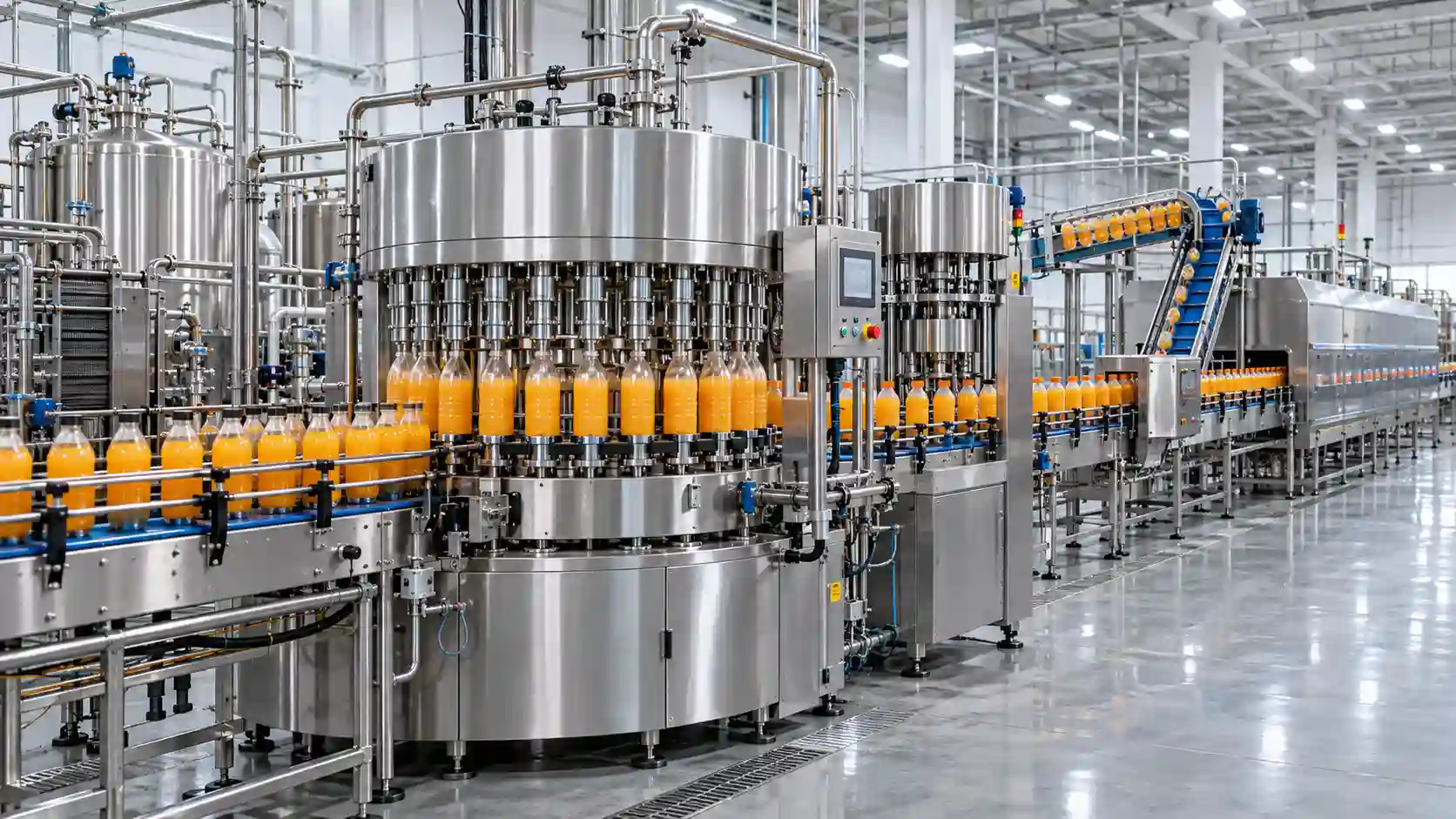
Buying a hot fill line isn't like ordering office furniture. Get capacity wrong, or pick the wrong bottle, and you'll feel it for years. So plan first, buy later. A well-thought-out Hot Fill Line starts with your product, your output target, your packaging and your hygiene standards — and leaves room to grow. Skip this step and corrections get expensive, fast.
This blog from J.PEE Engineers walks through the questions worth answering before you spend a rupee on a Beverage Bottling Plant. We'll keep it practical, with no jargon for jargon's sake.
Understand What a Hot Fill Line Does
Think of it as filling a drink while it's still hot. The heat does part of the safety work, and the bottle gets sealed right away. That's why a Hot Fill Bottling Line suits many non-carbonated drinks.
The Hot Fill Process runs in a fixed order, and it helps to know it before anything else:
- Product preparation, blended to the recipe
- Pasteurisation up to the set temperature
- Filling at a steady, controlled temperature
- Capping, then bottle inversion
- Cooling before labels and cartons
Miss one stage and the next one suffers. Treat the line as one system, not a pile of machines.
Identify the Beverages You Plan to Produce
Start with the drink. Everything else follows from it. Juices, nectars, RTD tea, sports drinks, functional beverages — they all suit a Beverage Hot Fill Line, yet each behaves differently in pumps and heat exchangers. A thick, pulpy nectar needs wider flow paths than thin tea, and a Juice Bottling Line should be built around that. Same logic for any Beverage Processing Line.
Watch these factors:
- Viscosity — thick drinks need pumps and valves that cope with the flow
- Pulp or fibre; it decides valve size and pipe diameter
- Formulation — acidity, sugar, additives; each one changes how much heat you need
Determine the Required Production Capacity
Be honest about numbers here. Start with today's output. Then guess — carefully — what you'll sell in two or three years, and how many hours a day the plant will actually run. Small lines suit a brand that's still testing the market; medium ones serve regional distribution; high-capacity systems handle big, steady orders. A Hot Fill Line Capacity a notch above today's need often costs less than replacing the line later. It also keeps your Beverage Production Line and overall Bottling Plant Capacity plan grounded.
Gather these first:
- Current monthly output
- Expected demand growth
- Daily hours and number of shifts
Choose the Right Bottle and Packaging Format
The bottle touches almost every machine on the line, so settle it early. PET is light and doesn't shatter, which buyers of juice and RTD drinks like — but it has to be heat-resistant, or it'll warp at filling temperature. Glass takes heat easily and looks premium. A PET Bottle Hot Fill Line and a glass setup handle containers differently. Get the Beverage Packaging right and you'll see fewer jams and leaks.
Confirm these with your bottle supplier:
- Heat resistance rating
- Bottle size and shape
- Neck finish, and whether your caps fit it
Plan the Main Equipment in the Hot Fill Line
A full line is several machines working in step. Speed and temperature handling must match across all of them. Know what each unit does and quotations become far easier to compare — that goes for your Hot Fill Line Equipment list and the wider Beverage Filling Line. Three areas matter most.
Product Preparation and Pasteurisation System
Here syrup, juice, water and additives get blended to the exact recipe. Then comes heating, done under tight control — this is the core of Hot Fill Processing. Thin, clear drinks usually pair well with plate exchangers. Pulpy or thick stuff? Tubular. Hold the temperature steady with a dependable Beverage Pasteurisation System, because patchy heating spoils taste and safety both.
Look for:
- Accurate temperature control
- Product-contact parts that are easy to clean
Hot Filling and Capping Equipment
Fill temperature and fill level — your Hot Filling Machine has to get both right on every single bottle. Valves should be hygienic; that's non-negotiable. Right after filling, the Hot Fill Capping Machine puts the cap on with steady torque. Skip shortcuts here.
Check:
- A stable filling temperature
- Accurate fill volume
- Capping that seals well and doesn't leak
- Quick changeover between bottle sizes
Bottle Inversion and Cooling System
Once the cap's on, bottles get flipped upside down for a bit. Why? Hot product reaches the cap and neck area, and that helps hygiene there. A Bottle Inversion System handles the flip. Then bottles have to cool — labelling, coding and packing can't start while they're still hot. A good Hot Fill Cooling System lowers the temperature gradually, so bottles don't lose shape.
What you gain:
- Cleaner cap area
- Bottles that keep their shape
- Safe handling further down the line
Decide the Level of Automation
Think about three things: volume, labour, and how consistent your bottles need to look and taste. Semi-automatic is cheaper and fine for small batches — but it leans on your operators. Fully automatic runs with hardly any intervention and holds steady as volumes climb. An Automatic Hot Fill Line built as a PLC Hot Fill Line makes settings repeatable, and good Beverage Bottling Automation cuts human error. J.PEE Engineers offers both configurations.
Here's the quick comparison:
- Semi-automatic — lower investment, but more hands on the job
- Fully automatic: higher output, steady quality
- Growth — automatic lines scale up more easily
Plan for Hygiene and Food Safety
Hot filling helps, sure. But the equipment itself needs to be clean by design. Stainless steel (food grade) on every part the product touches — it resists corrosion and wipes down fast. Enclosed processing keeps air and dust out. Steady temperatures leave no weak spots. A Hygienic Hot Fill Line made from Food Grade Beverage Equipment also needs a tidy layout, with raw material and finished goods kept apart. J.PEE Engineers builds projects to BIS, FSSAI and IS 14543 standards.
Bake in these habits:
- Easy access for cleaning
- Smooth surfaces, no crevices
- A fixed sanitation routine
Consider Utilities and Plant Layout
Great machines still struggle in a badly planned room. Check the basics before you order: is there clean water, steady power, compressed air, a drain that actually works? Then sketch the floor: product moving one way, operators with space to work, technicians able to reach every machine. Sound Beverage Plant Layout planning cuts congestion, and a smart Hot Fill Plant Setup saves effort daily.
Go through these with your engineers:
- Water, power and air supply
- Floor space and ceiling height
- Room for maintenance and cleaning
Allow for Future Expansion and Product Changes
Plenty of buyers outgrow their plant sooner than expected. Dodge that by choosing scalable machinery and leaving layout space for extra units. Ask whether the line runs several bottle sizes, and whether it can switch beverages without long stoppages. A Scalable Hot Fill Line lets your Beverage Processing Plant add products, sizes and capacity without a rebuild. J.PEE Engineers designs scalable plants for exactly this.
Plan for:
- More bottle sizes
- New beverage variants
- Capacity upgrades
What to Check Before Finalising a Hot Fill Line Supplier
Honestly, the supplier counts as much as the machine. A dependable Hot Fill Line Supplier should design around what you need, help with installation, and still pick up the phone after commissioning. When you compare any Hot Fill Line Manufacturer, look at track record and in-house capability. Search for Hot Fill Line Manufacturers in India and you'll get plenty of names — so verify before shortlisting. Since 2001, J.PEE Engineers has handled plant design, site visits, commissioning, training and spare parts, all from one team.
Use this checklist:
- Engineering capability and customisation
- Installation and commissioning support
- Operator training
- Spare parts availability.
- After-sales service
Conclusion
Good hot fill planning is really about fit — beverage, packaging, capacity, automation, hygiene and future growth all pulling in the same direction. Take the decisions one by one, bring experienced engineers in early, and plan past today's volumes. Ready to explore a complete Hot Fill Line for your Beverage Bottling Plant? Visit the J.PEE Engineers Hot Fill Line page and talk through your requirements.
|
Looking for a dependable hot fill line manufacturer in India? Talk to J.PEE Engineers to discuss your beverage, capacity and bottle requirements. |
Frequently Asked Questions
A hot fill line fills non-carbonated drinks — juices, nectars, RTD tea, sports drinks — into bottles at a controlled high temperature. The heat helps preserve the product, and the bottle is sealed right away. It works well for many high-acid beverages and sits at the centre of any bottling setup.
Heat-resistant PET and glass both work. PET is lighter and easier to move around, but it has to be made for hot filling temperatures. Glass handles heat easily and looks premium. Whichever you choose, confirm heat rating, neck finish and cap fit with your supplier before locking in beverage packaging.
Begin with today's output. Add the demand you expect over the next few years, plus daily running hours. Going slightly above current needs usually avoids an early replacement. Hand those numbers to your engineers so the hot fill line capacity fits both your budget and your growth plans.
Depends on volume and labour. Semi-automatic lines cost less and suit small batches. An automatic hot fill line gives steadier output with less manual effort. If you expect quick growth, a fully automatic or PLC-based setup is usually the safer long-term bet for consistent product quality.
Turning the bottle upside down briefly lets hot products touch the cap and neck area, which supports hygiene in those spots. Controlled cooling follows. A well-planned bottle inversion system plus a proper cooling stage also protects bottle shape before labelling and packing. Simple, but it matters.
Check engineering capability, customisation, installation support, operator training, spare parts and after-sales service. Ask for completed projects and how layouts get planned. Clear answers show real experience. A trusted hot fill line manufacturer like J.PEE Engineers offers design, commissioning and training together in one place, which keeps the project simpler.
