
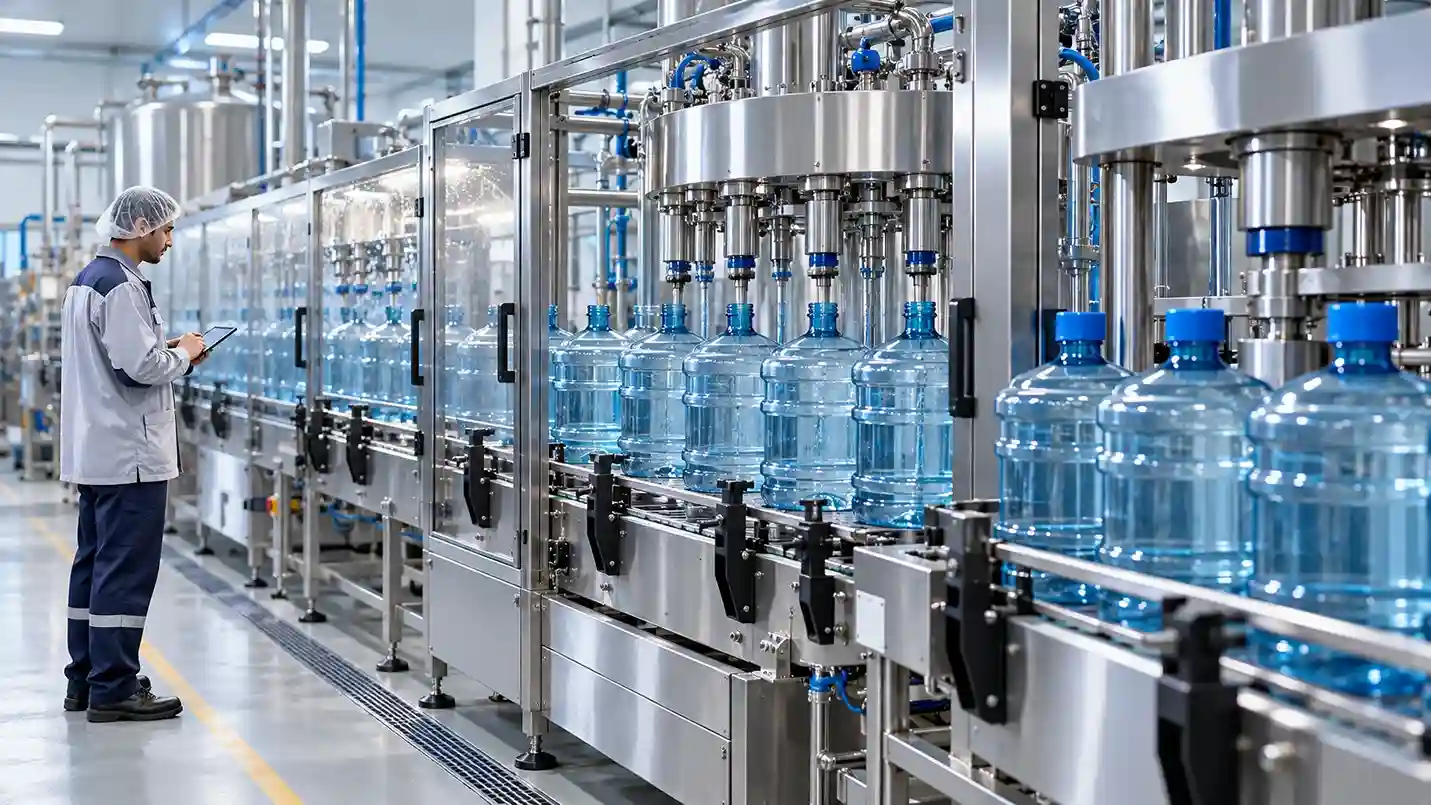
An easy-to-understand guideline for determining the right size of washing, filling and capping to make sure your factory produces as per expectations
The selection of equipment is an easier task. The number of jars that must be filled by the equipment is a difficult one, and quite often this is done incorrectly by many owners. If you size it too small, your orders will keep piling up; size it too large and money will be lying around unused. An efficient jar filling line will meet all these criteria along with any other packed drinking water plant.
Why Is Jar Filling Line Capacity Planning Important?
A wrong jar filling line capacity figure costs money in both directions. An oversized line raises power and crew costs, while an undersized one loses customers over time. Here is what a poor estimate usually causes in daily operations:
- Machine capacity that never gets used
- Missed deliveries in busy weeks
- One slow station holding back the rest
- Higher cost per jar on half-empty shifts
7 Key Factors to Consider When Planning Jar Filling Line Capacity
Seven steps transform hunches into an organised strategy. Do them in sequence, for each depends on the other, so have your plant numbers ready.
Estimate Daily Water Jar Production Demand
Start with real orders, not machines. Forecast sales and actual production are different numbers, since you also need a small stock buffer. A water jar production capacity target built on real orders is far safer for planning. Gather these figures first:
- Average jars sold on a normal day
- Peak-day demand in summer or during events.
- Working days per month, plus a 10% stock buffer.
Select the Required Jar Sizes and Formats
Most of the crops will require 5 litres, 10 litres, and 20 litres jars. Bigger jars take longer to clean and fill and changing sizes results in stopping the line. A 20 litre jar filling machine that fills only one size for the whole day produces more than if it changes sizes. Remember to consider the following when considering each size:
- Size specifications of the jar and its neck
- Volume per jar ranging from 5 to 20 litres
- What is the actual time taken to change sizes?
Calculate Required Jars Per Hour
Now turn the daily target into an hourly one. Breaks, cleaning and changeovers eat into every shift, so clock time overstates what you get. Your jars per hour requirement follows this order, with room to spare:
- Take the daily target with the stock buffer already added.
- Divide by the hours the line truly runs after breaks.
- Add an allowance for stoppages and changeovers.
Match Jar Washing, Filling and Capping Speeds
The speed of any production line is determined by that of the slowest unit: a washer processing 500 jars an hour, supplying a filler of 800 jars will give only 500. J.PEE Engineers match washer, filler and capper speeds in a single jar washing filling capping machine system. Take a look at these and see where the bottlenecks may be:
- Washer: Set by time per jar to rinse
- Filler: Look into the fill cycle and the number of heads.
- Capper: See how fast caps are fed and sealed
| TIP: It’s often the washer that sets the actual pace, as all recycled jars must be rinsed both externally and internally before filling. |
Evaluate Automation and Labour Requirements
A semi automatic jar filling machine requires manual loading, transport and possibly capping of jars, working fine for small-scale operations. A fully automatic jar filling line moves jars through all operations with minimal handling. Apply this comparison to make your choice:
- Semi-automatic: Low investment, many operators, flexible output.
- Automatic: High investment, fewer operators, constant speed.
- Small daily volumes favour the first; large ones favour the second.
Check Water Treatment Capacity and Utilities
Machines cannot fill water the treatment plant has not made. Jar filling plant utilities decide whether rated speed is ever reached. Verify these before finalising plant size:
- Treated-water output per hour, against filling speed.
- Rinsing and washing water consumption per jar.
- Treated-water storage tank volume to bridge treatment and filling gaps.
- Electrical load, plus compressed air where machines need it.
Plan for Downtime and Future Capacity Expansion
All machines have their designed speed and actual speed. Maintenance, setup, and rejects lower the actual speed; the usual range is between 80% and 85%. Excellent efficiency in your jar filling line allows room for future growth. Make note of:
- Free floor space next to the line for adding stations.
- Water treatment and storage with available capacity.
- The ability of the machines to take up a faster filler or washer.
How to Calculate Jar Filling Line Capacity: Practical Example
Consider an example of a factory producing 3,600 jars of 20 litre volume per day. With 10% allowance added, the capacity is increased to 3,960. An 8-hour production cycle consumes 1 hour for breaks and cleaning and so leaves 7 hours. The formula for determining the jar filling line capacity calculation would be as follows:
- 3,960 jars divided by 7 hours is approximately 566 jars per hour.
- This is equal to approximately 11,320 litres per hour.
- Given that there is 85% efficiency, the speed rating should be approximately 666 jars per hour.
- Increase the rating to 700.
The effective capacity on the factory floor will be around 600.
Common Capacity Planning Mistakes in Water Jar Plants
Many errors repeat from plant to plant. Owners buy on advertised speed alone and later find real output far lower. Water plant bottlenecks cost far more to fix after installation. Watch out for these slips:
- Choosing a machine by headline speed
- Skipping a check on washing capacity
- Ignoring extra cleaning for returned jars
- Sizing for an average day, then meeting peak weeks unprepared.
What to Check Before Investing in a Jar Filling Line
Ask for proof, since brochure speeds can mislead. A supplier planning the whole plant, like J.PEE Engineers, gives firmer estimates. When you shortlist jar filling line manufacturers in India, compare these points:
- Written specifications and rated output
- Washer, filler and capper working as one unit
- Line layout, output test, spare parts
- Commissioning support and scalability
Conclusion
An efficiently performing jar filling line is designed in the drawing board prior to procurement. Calculate your actual orders daily, translate them into hourly rate of jars and ensure that washer, filler, and capper are able to cope up with each other. After that factor in your downtime and room for growth. Do this, and the line you will set up will give you your promise to your clients. Armed with proper calculations, J.PEE Engineers can help you set this up in your factory.
|
Ready to size your water jar plant with confidence? Talk to J.PEE Engineers today. Share your daily jar target and get a line matched to your output and budget. |
Frequently Asked Questions
Divide your daily jars objective, along with little safety margin, by running hours of the line, and then divide it further with line efficiency, mostly 85%. It gives the required rated speed. For example, 3,960 jars in 7 hours with 85% give you nearly 666 jars per hour.
The washing speed, filling cycle, capping speed, availability of clean empty jars and unexpected downtime affect its production. The slowest among these determines the overall performance. Even a fast 20 litre jar filling machine is idle because of the delay in arrival of jars or because the capping machine jams in busy hours.
It is possible if done early. The specification needs to confirm the possibility of adding a faster station, there should be some unused space on the floor for installation, and the electricity and water system should be capable enough to handle extra load. Generally, the expansion of a jar filling line is simply an upgrade of the slower station, like a washer.
In most plants, 80 to 85% is planned. Time for breaks, cleaning, changeovers and defective jars is inevitable during each shift. This means that while the maximum rate may be 700 jars per hour, the actual number that would be produced in a normal workday will be around 560 to 600 jars.
Look at the production volume and labor costs. A smaller plant can use a semi-automatic filling machine since its cost is low. An increase in demand would mean using an automatic filling system for greater efficiency and reduced labor force. Compare the two to your demand for the next three years before making a decision.
The minimum amount required is equal to the maximum production rate, in addition to other factors such as rinsing and washing. For instance, if 566 jars of 20 liters per hour are being filled in the factory, then the total requirement of treated water would exceed 11,000 liters.
